Second Wind & Scenery Change
What changed for Cam Fowler after the trade to St. Louis?


I wanted to spend more time on the Cam Fowler trade from last season, just because he’s a higher roster player who switched teams pretty early in the season & it’s always interesting to see if the change in scenery aspect is real or not. Now that he’s signed a new contract in St. Louis, I have an excuse to revisit this trade. Most of the time, the player’s performance stays the same but the on-ice results change. A player that eats minuses and chances against can have that flipped on its head after going to a new team. It’s not always the case, but it was for Cam Folwer. He went from a guy posting sub-45% xGF rates for years & Goals For% in the low 40’s to a 52.7% xGF & a 62.9% Goals For in 51 games with the Blues. He also capped this off with a phenomenal showing in St. Louis’ playoff series against the Jets. You can call it a return to form, but it was more like a career revitalization for the veteran blue-liner.
Evaluating defensemen is a tough gig and it’s especially true for a minute eater like Fowler. He has seen all sides of a rebuild in 14 years with the Ducks and is at the point of his career where most defensemen start to hit a wall. The early 30’s are usually a tough time for players and it’s especially true for a guy with a lot of miles on his tires like Fowler. The puck-moving, minute-eating defenseman is probably the toughest role on a bad team because it’s almost impossible to gauge your performance when the results are always so bad.
Fowler’s always been an interesting player to me, as someone who watches the Ducks periodically. He’s someone I refer to as an “anonymous top pair defenseman” because he’s never been a huge point producer and has never been considered a top-10 defenseman at any point of his career. Even in his prime he might not have been Anaheim’s best defenseman with Hampus Lindholm also hanging around. Fowler just always did his job, logging a lot of minutes and playing in all situations to be a stabilizing presence. That started to fade the last couple of seasons with his minutes going into the 25+ range and his on-ice numbers continuing to get uglier. So you start to ask the question if his numbers are bad because of the environment or is he part of the problem?
The Blues took a gamble on it being the former when they made the trade for him, the only risk being on the hook for Fowler’s $6.5 mil cap hit the following season if he bombed, which is a moot point now. Trades like this aren’t rare, but they usually happen later in the season at the deadline, so I had a lot of interest in this deal because Fowler would basically get a full season on his new team. The Blues were also in a murky spot when they got him, they just switched coaches and are in the “figuring shit out” stage of their team timeline rather than a rebuild. They’re not in the rebuild trenches & have enough good players at the top of the roster to be a playoff team, but not enough quality in the middle of their roster & their floor ends up being very low because of that. So Fowler in a quasi-top-pair role with slightly reduced minutes could be somewhat of a game-changer for them to get out of the doldrums of the standings. The Blues also weren’t a strong play-driving team last year, but they have been more creative in their approach to work around it with how good they are off the rush. So adding Fowler into the mix was more of boom-or-bust type of situation.
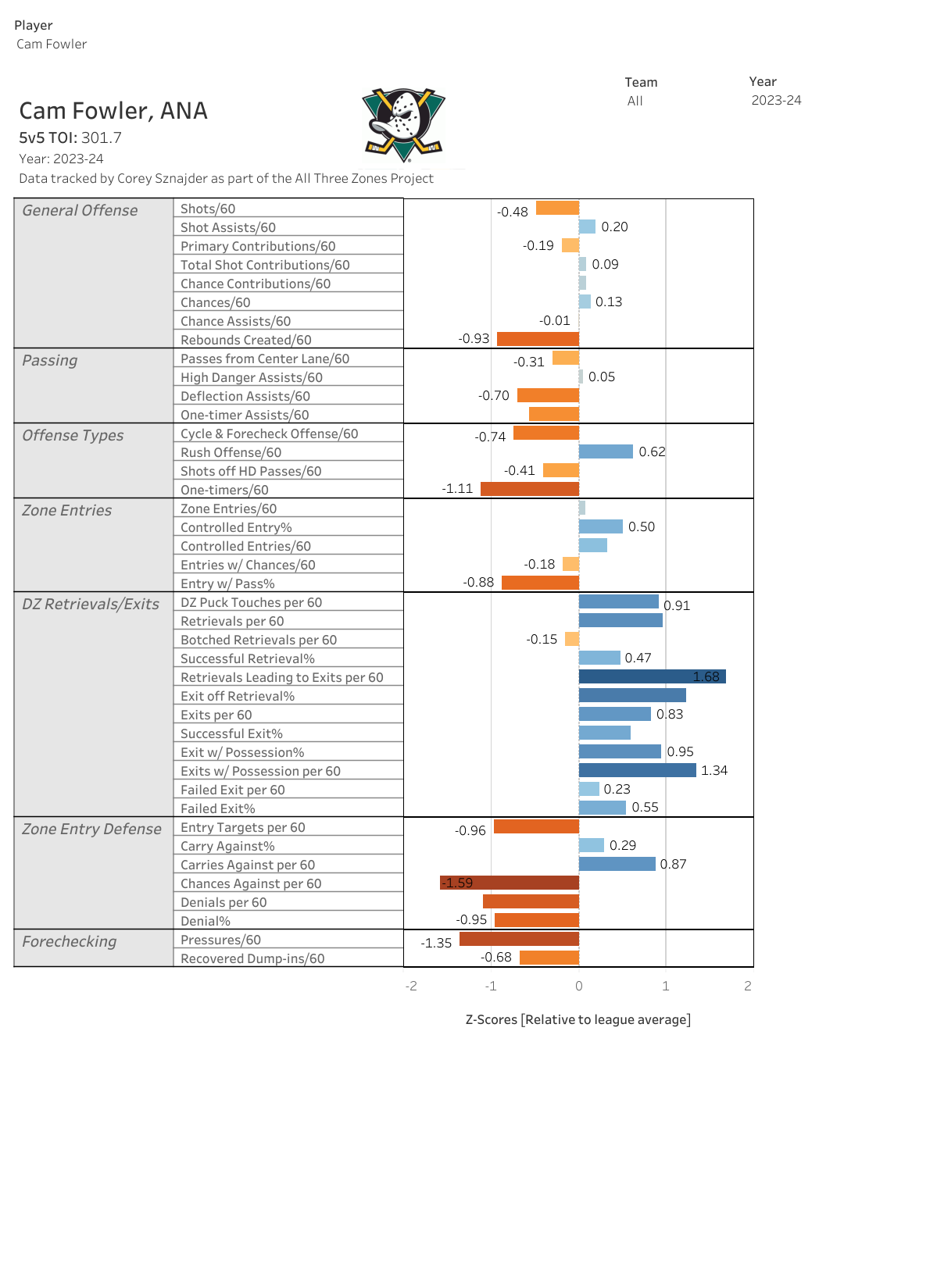
Going by the results, it appeared to do just that. What was interesting to me was how little his performance changed by the A3Z stats. Defensemen generally have more control over these so it’s not a surprise, but sometimes a player can struggle with exits in a system where he’s starting breakouts from a standstill to stationary forwards or constantly under duress in the defensive zone. Last week we talked about Jackson LaCombe and how he’s “system proof” in a way because of how good of a passer he is and how good he is at recovering dead plays to give the Ducks a second or third chance at starting a rush. Fowler’s skating and his passing have always been his best traits, but he might not be the guy to change the foundation of a game but rather someone who can excel within a system that’s already in place.
Comparing his Anaheim numbers from 2023-24
To his numbers with the Blues in 2024-25
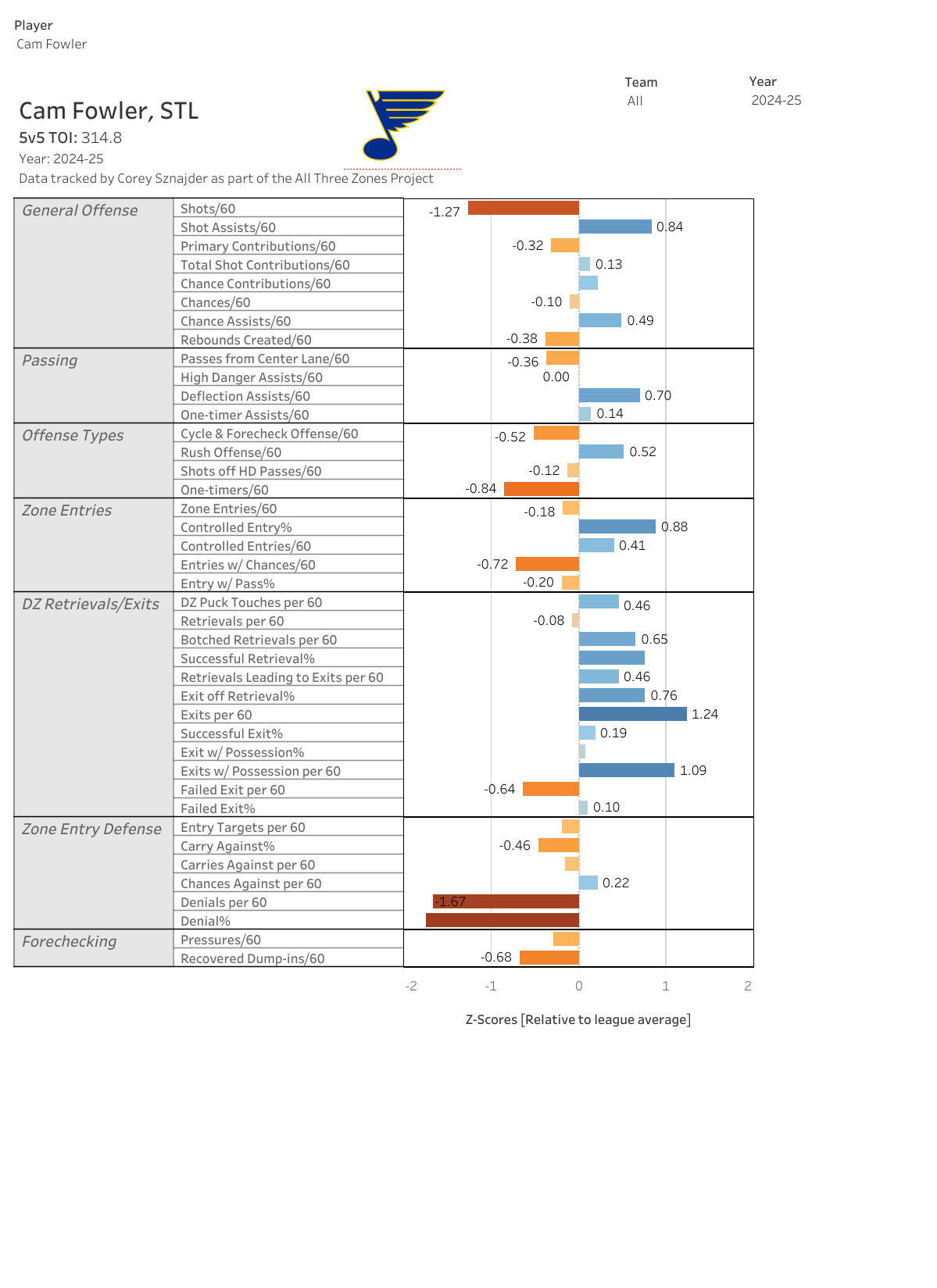
As it always with these charts, it’s a lot of data to take in so I’m going to split it into what stayed the same and what changed.
What Stayed The Same
Fowler’s A3Z profile on both teams follows a similar pattern. He’s a pass-first, playmaking defenseman that likes to join the rush & he gets most of his offense from there. Whether that’s starting a play out of his own zone or acting the extra attacker. He was also good at starting exits with the Ducks despite the ugly on-ice numbers. His workload went down, but the efficiency was at about the same rate. How he defended his blue line is the final big thing that stayed the same. This isn’t to say that he’s a passive defender who gives up large gaps to opposing forwards, but he is in more of the “get in the way” mold rather than using his stick or going for a poke check to jar the puck loose. He’ll let the play come into his own end and try to sort things out from then, likely trusting his puck skills to start a breakout. Everyone plays to their strengths in different ways.
What Changed?
So, Fowler’s game didn’t change too much after the trade to the Blues. What did change was how often he was the guy leading the breakouts and how often teams created chances when entering the zone against him. He played alongside Parayko (who I call the Sleep Token of hockey because if you look at people rating their big album, it’s an equal amount of who love it or think it’s garbage), who does most of the retrieval work so Fowler doesn’t need to be the guy doing everything in St. Louis.
There’s also some detailed things in the offensive zone that he improved at with the Blues. He was setting up higher quality shots like deflections & one-timers, which is obviously a supporting cast thing. The Blues have a low-volume, high-quality approach to offense and a talented forward group who can complement Fowler’s game well & vice versa. The Blues also having more layers to their rush offense, attacking more from the neutral zone in off reloads, compared to Anaheim who could only generate off controlled breakouts also probably helped Fowler translate some of his individual stats into better on-ice results a little bit too.
There’s one shift I want to highlight from this same game to illustrate this point.
In the first half, you get a look at some of Fowler’s tendencies, he really likes to play centerfield while the Blues are forechecking so he can pick off passes in the neutral zone & strike the other way. He’s got the precision to pull this off, but it’s somewhat of a high-risk play sometimes & you’re at the mercy of your forwards finishing the chance to make it count. Kyrou only gets a long-distance shot here, albeit a heavy one.
The play goes back & Fowler tries a similar approach but retreats into his own zone & the Wild quickly swarm on him to kill the breakout. This is where things can go off the rails for some teams, but the Blues survive this sequence giving up a couple of quick shots with traffic. Where Fowler does a good job here is bailing out Nick Leddy after a missed breakout and he makes the safe outlet to Holloway to end a long shift. This could have been a disastrous sequence & there might have been times in Anaheim where Fowler was either pinned into his zone for awhile or given up some better chances because the defensive zone structure was more chaotic there than it was in St. Louis. Fowler retreating into his own zone started it, but he cleaned up his own mess later in the shift. Basically showing how a player’s tendencies can work for or against him & how the level of risk can change depending on the environment.
As far as his new deal goes, it’s risky whenever you’re going to commit to a defenseman when they’re this late into their career because you never know when that wall is coming. While Fowler’s overall numbers in Anaheim were ugly, he showed enough that it wasn’t all on him & a change of scenery could help. The Ducks were also looking to move on with younger defensemen needing more ice time, so the trade helped both parties well.